Balancing the Game Within the Game
The balancing act of coaching
In today’s game, coaching isn’t just about drawing up plays or chasing wins—it’s about managing a constant tug-of-war between competing priorities. Winning matters. Development matters. Effort matters. Accountability matters. And somewhere in the middle of all that… making sure kids actually enjoy the game still matters too.
That’s the reality every coach lives in.
Managing the full picture
You’re trying to reward players who bring energy and effort. You’re working to keep morale high across an entire roster. You’re holding kids accountable when they fall short. At the same time, you’re navigating playing time—figuring out who’s earned more opportunity, who needs to grow, and how to keep it all fair within the context of the team.
It’s not easy. And it’s never perfect.
Looking beyond the stats
That’s why, in our program, we lean into stats and analytics—not just to evaluate performance, but to understand impact. We track scoring, assists, turnovers, rebounds. We look at plus/minus. But beyond the numbers, we study something just as important: body language.
Because numbers tell part of the story. Attitude tells the rest.
The toughness required to grow
As much as we want players to have fun—and we do—we also need toughness. Not just from players, but from parents too. Toughness to accept coaching. Toughness to embrace hard truths. Toughness to prioritize what’s best for the team, not just the individual.
And when things aren’t going your way?
That’s where growth begins.
If your child is struggling, the answer isn’t pointing fingers—at coaches or at the kid. The answer is finding a way to improve. There are countless ways to do that: extra reps, film study, asking questions, embracing feedback.
A mindset that separates players
One moment this past weekend said it all.
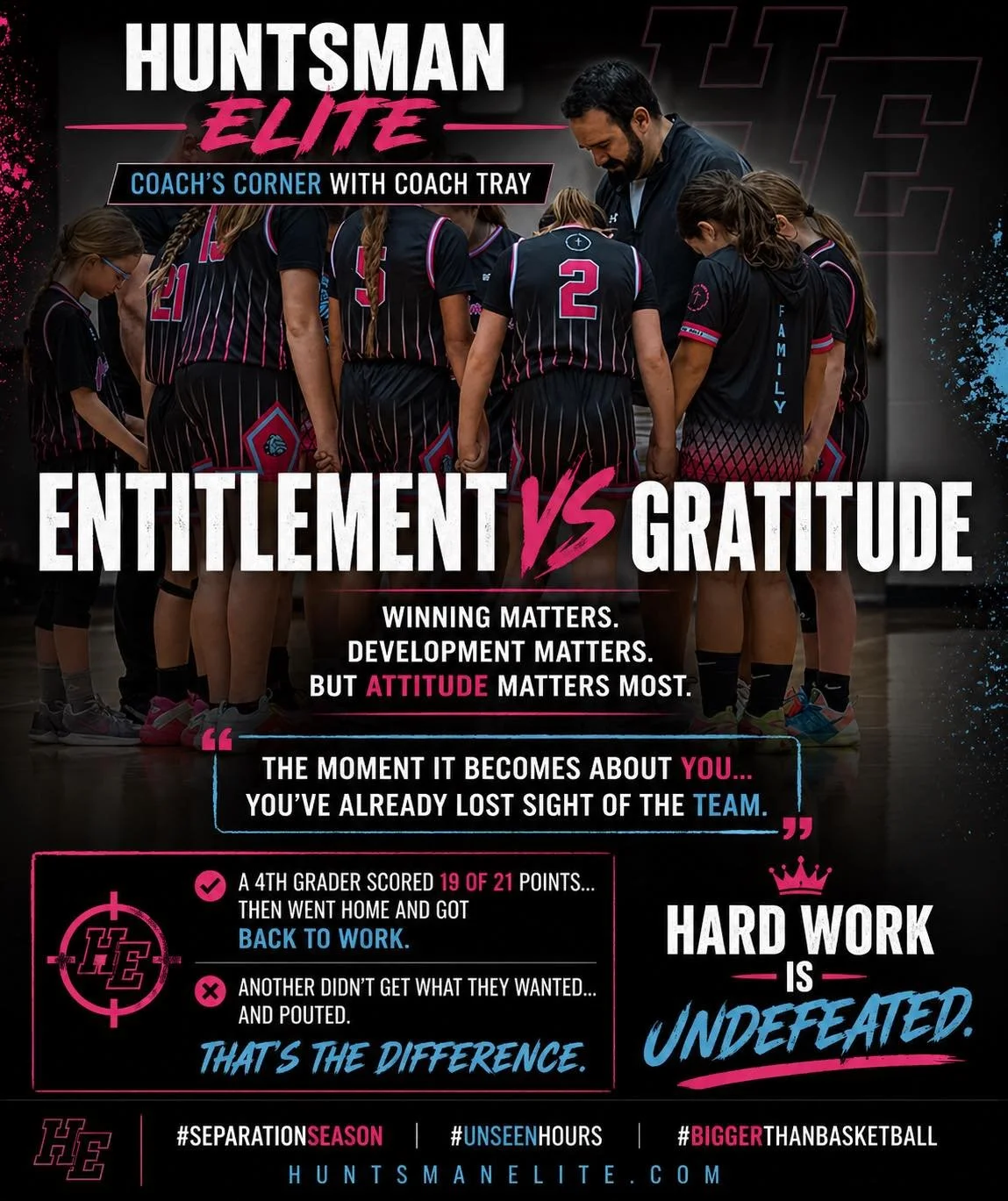
A young lady in our program scored 19 of her team’s 21 points in a win. Dominant performance. Confidence. Production. She played most of the game and delivered when it mattered.
So I called to congratulate her.
Her mom told me she was outside working on her game.
Let that sink in.
After a performance most kids would celebrate, she was already back in the lab—because on the drive home, she had been watching film of herself, identifying areas she could improve for the next day.
A 4th grader.
That’s the difference.
That’s the mindset.
Entitlement vs. gratitude
Meanwhile, on the other side, you’ll see players who don’t get what they think they deserve—and instead of responding with growth, they respond with frustration. Pouting. Complaining. Disconnecting from the team.
That’s where the line gets drawn: entitlement vs. gratitude.
The moment entitlement creeps in, development starts to stall.
Coaches can see it instantly. One of the clearest indicators? When the team wins—and a player is still upset.
That only happens when the focus shifts from we to me.
The truth about growth
Now let’s be real—there are situations in sports where politics exist. There are times when kids don’t get opportunities they may deserve. That’s part of the game, and it’s frustrating. No one’s ignoring that reality.
But here’s what remains true every single time:
Hard work is undefeated.
If you’re willing to evaluate yourself honestly…
If you’re open to feedback…
If you attack your weaknesses instead of avoiding them…
Growth will come.
It always does.
The Huntsman standard
And in the Huntsman culture, that’s what we’re chasing—not just wins on the scoreboard, but wins in mindset, habits, and long-term development.
Because in the end, the players who separate themselves aren’t the ones who feel entitled to success…
They’re the ones who go earn it.